


If you’re up worrying about what happens at 2 AM, you’re not alone. Families ask us this all the time: what if something goes wrong at night? How fast can someone actually get there? We’re not here to hand you a glossy brochure and hope for the best. We’re here to walk you through exactly what happens, hour by hour, so you can stop guessing and start trusting that someone genuinely has this covered.
Why families ask “what happens at night?
It’s usually not the daytime stuff that keeps people awake. It’s the 2 AM fall. The medication that doesn’t seem right. The moment someone feels unsafe and there’s no one around to notice.
Every disability support provider says “24/7” somewhere on their website. It’s an easy line to write. It means almost nothing until you know who actually picks up the phone, how long it takes them to answer, and what they do once they’re on the other end.
That’s the real question underneath “what happens at night?” It’s not really about hours of operation. It’s about whether a real person, who knows your situation, is going to show up when it counts.
So let’s answer it properly, step by step.
How our team responds after hours?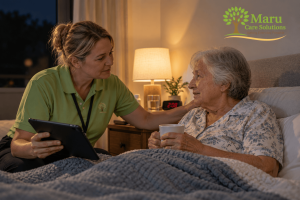
Overnight and on weekends, we have support workers rostered on shift for participants who need someone physically present, plus an on-call coordinator who’s reachable for everyone else in our care.
Here’s how it actually plays out:
- You call our after-hours line. It’s answered by a real person, not a message bank that promises a callback “within 24 hours.”
- They already know who you are. Our on-call team has access to each participant’s plan and history, so you’re not starting from scratch at 2 AM explaining who you are and what’s going on.
- They act straight away. Depending on what’s happening, that might mean talking you through it on the phone, waking the on-call coordinator, or getting a support worker moving toward you.
We aim to have a response underway within minutes of your call, not hours. If it’s urgent, you’ll know someone is acting on it before you’ve even hung up the phone.
What counts as an emergency, and what doesn’t?
Short answer: whatever feels like one to you.
Some situations are clearly urgent:
- A fall, especially if there’s pain, confusion, or an inability to get up
- A medication issue, wrong dose, missed dose, or a bad reaction
- Feeling unsafe, whether that’s physical, emotional, or something’s just not right
Others can usually wait until morning:
- A question about tomorrow’s appointment
- A change to next week’s roster
- General wondering that isn’t urgent but is nagging at you
We’ll help you work out which is which if you’re not sure. For anything medical or dangerous, we’ll call an ambulance immediately, no hesitation, no waiting to see if it settles down. For things that need a doctor’s input but aren’t emergencies, we’ll contact the participant’s regular GP where that’s appropriate.
Here’s the honest truth: we’d rather you call and it turns out to be nothing, than you sit there worrying because you didn’t want to “bother” anyone. There’s no wrong reason to call us. That’s what we’re here for.
The difference real-life experience makes overnight
A care plan can tell a support worker what medication someone’s on, what their routine looks like, what to do if there’s a seizure. What it can’t teach is judgement, and at 2 AM, judgement is often what matters most.
There’s a difference between a worker who’s read the plan and a worker who’s actually sat with someone through a rough night before. The first one follows the steps. The second one notices the small thing that doesn’t fit the pattern, the tone of voice that’s slightly off, the hesitation before answering a question, and knows to ask one more question before deciding what to do next.
We had a situation once where a participant’s breathing sounded a little different overnight, nothing dramatic, nothing the written plan flagged. A worker who’d been there before recognised it wasn’t right and acted early, rather than waiting for it to become obviously urgent. That’s not a checklist skill. That’s experience.
This is the whole idea behind how we work. We’re not here to manage people according to a document. We’re here to walk alongside them, awake at 2 AM if that’s what the night calls for.
How families stay in the loop?
If something happens overnight, you’ll hear from us. Depending on what occurred, that’s either straight away (for anything serious) or first thing the next morning with a clear rundown of what happened and what we did about it.
We also fold overnight incidents back into the participant’s actual NDIS plan and goals, not as a tick-box report, but as something that genuinely shapes how support is delivered going forward. If a pattern shows up, say, falls happening around the same time each night, that changes what we watch for next time.
If you want more detail on overnight arrangements before you commit to anything, that’s a conversation worth having early. Ask to speak with our care coordination team. They’ll walk you through exactly what overnight support would look like for your specific situation, not a generic version of it.
Talk to us about your after-hours support
If you’ve got a specific “what if” running through your head right now, ask us. Directly. We’d rather answer your actual question than have you guess based on a brochure.
If you’re weighing up round-the-clock support, our Supported Independent Living options might be worth exploring too, especially if overnight peace of mind is the main thing you’re after.
However you reach us, you’ll get a real person who’s genuinely present, not a corporate hotline reading from a script. That’s the whole point.